CompassStu
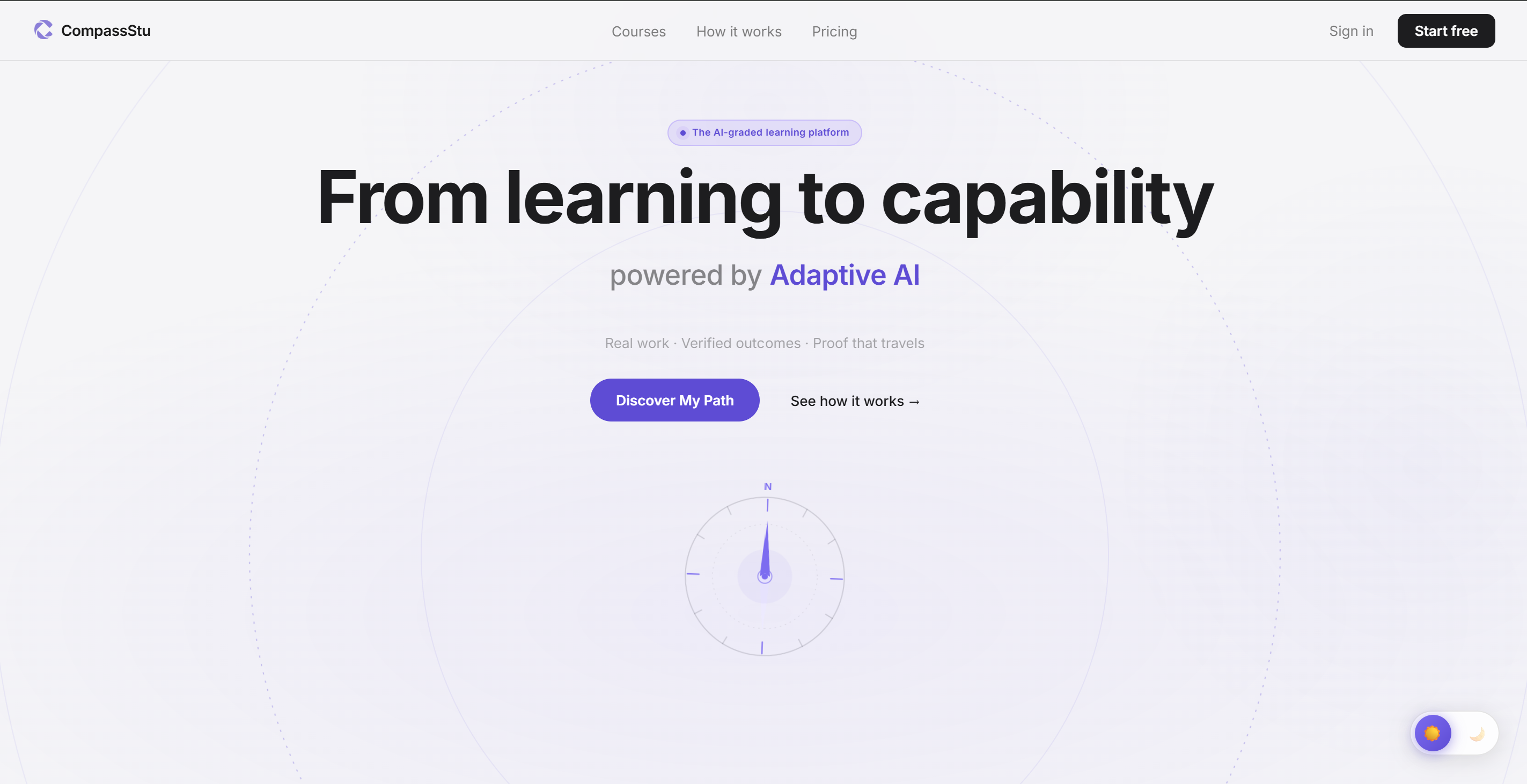
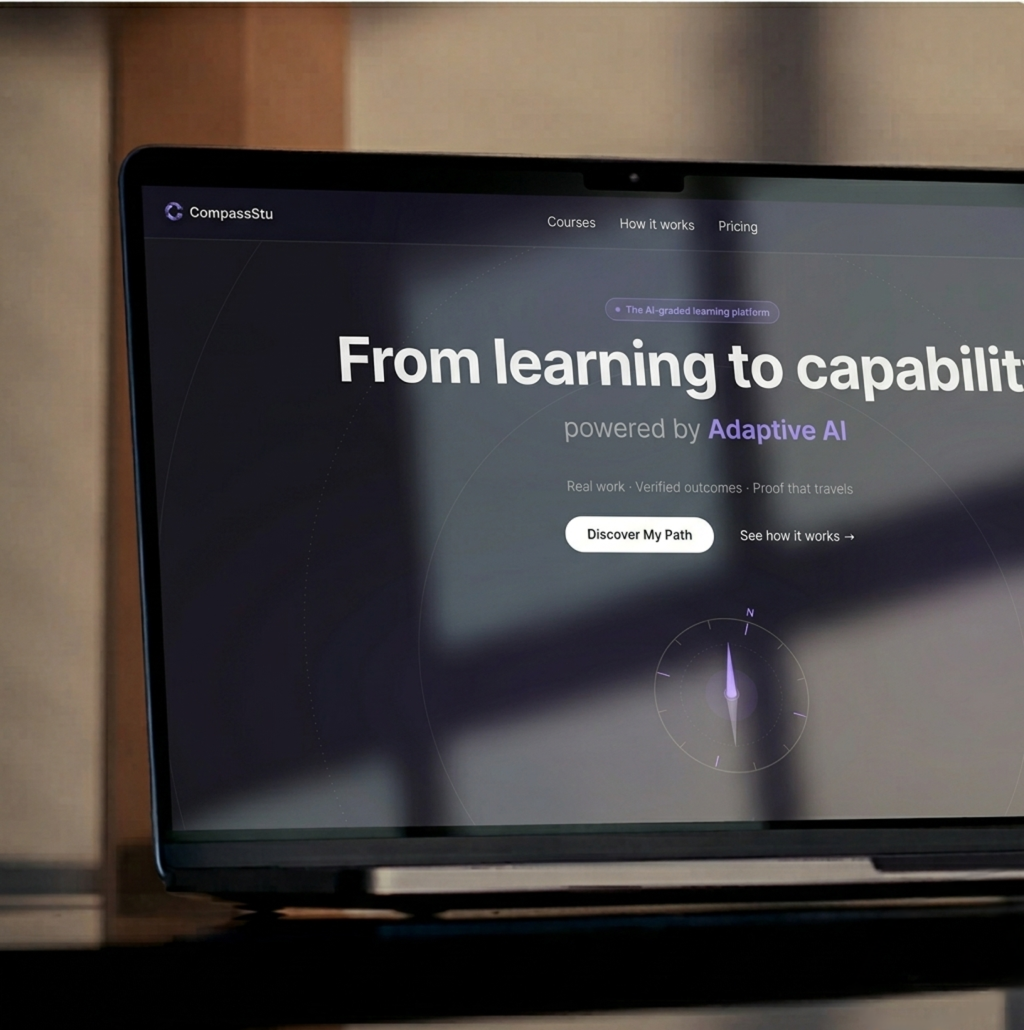
A learning platform built to produce candidates, not completions.
Most platforms measure progress in videos watched.
01 Overview
CompassStu measures it in work demonstrated — AI-graded against a four-dimension rubric.
Scored, signed, and shareable as a single URL an employer can verify in a click.
Time-stamped. Immutable.
One runtime. Three learning engines.
Adaptive paths. Fixed standard.
02 The Problem
The adult upskilling industry is large, well-funded, and broken at the seam that matters most — the handoff to a job.
Today's platforms compete on catalog size and completion rate. They measure what is easy to count: hours watched, modules finished, certificates issued. None of it tells an employer whether the learner can do the work.
The result is a market full of certificates no one trusts.
Recruiters discount them.
Hiring managers ask for take-home tests anyway.
Learners pay for signal that does not carry.
- What platforms count.
- Hours watched. Courses completed.
- What employers need.
- Work demonstrated. Standards met.
03 Product Thesis
We do not sell knowledge. We produce candidates.
Every course is built on the same three-layer pipeline.
- Learn.
- Active recall, not passive video. Eight-to-ten minute lessons engineered for attention.
- Simulate.
- AI-graded bridge tasks. Real work, scored against a four-dimension rubric.
- Prove.
- A timestamped, verifiable record an employer can read in a single URL.
04 Three Learning Engines
The Learn → Simulate → Prove pipeline runs identically every time — what changes is the cognitive demand it makes.
Concept Engine
For frameworks, persuasion, and high-stakes judgment. Graded on clarity of thinking, structural depth, and contextual relevance.
Operator Engine
For execution and technical precision — syntax, deployment, infrastructure. Graded on structural correctness and elegance of solution.
Analyst Engine
For data-driven environments. Graded on methodology, signal isolation, and the rigor of the argument.
05 Learning Experience Design
A CompassStu lesson lasts eight to ten minutes. It runs on a three-panel page and a vocabulary of twelve cards.
The page
A fixed grid. Module navigation on the left, one card in the centre, the tutor panel on the right. Nothing else moves. Only the card area scrolls.
The cards
Each lesson uses seven to twelve cards. Every card gates the next — a prediction has to be revealed, a quick check answered, an apply question written before the learner can advance. The first required input arrives within forty-five seconds.
The close
The final card is a mastery check — two short questions and a confidence selection. On submit, the lesson is marked complete and the learner is handed off to the bridge task, where the work that earns the certificate begins.
06 Compass Tutor
An AI coach built into every lesson — course-scoped, bilingual, with every reply verified before it reaches the screen.
Compass Tutor runs inside every lesson. It knows the course, the module, and the card the learner is on. Every reply it generates is passed through a second AI check — any answer that contradicts the lesson is blocked before it reaches the screen.
In teach-back mode, the learner explains a concept in their own words and the tutor evaluates comprehension, surfacing exactly what was missed.
- Course-Aware Context.
- Scoped to the current lesson. Never answers outside the curriculum boundary, regardless of how the question is phrased.
- Bilingual.
- Responds in English or Mandarin based on the course language — no setting to switch.
- Teach-Back Mode.
- Learner explains the concept back; the AI evaluates comprehension and flags the specific gap.
07 Adaptive AI Engine
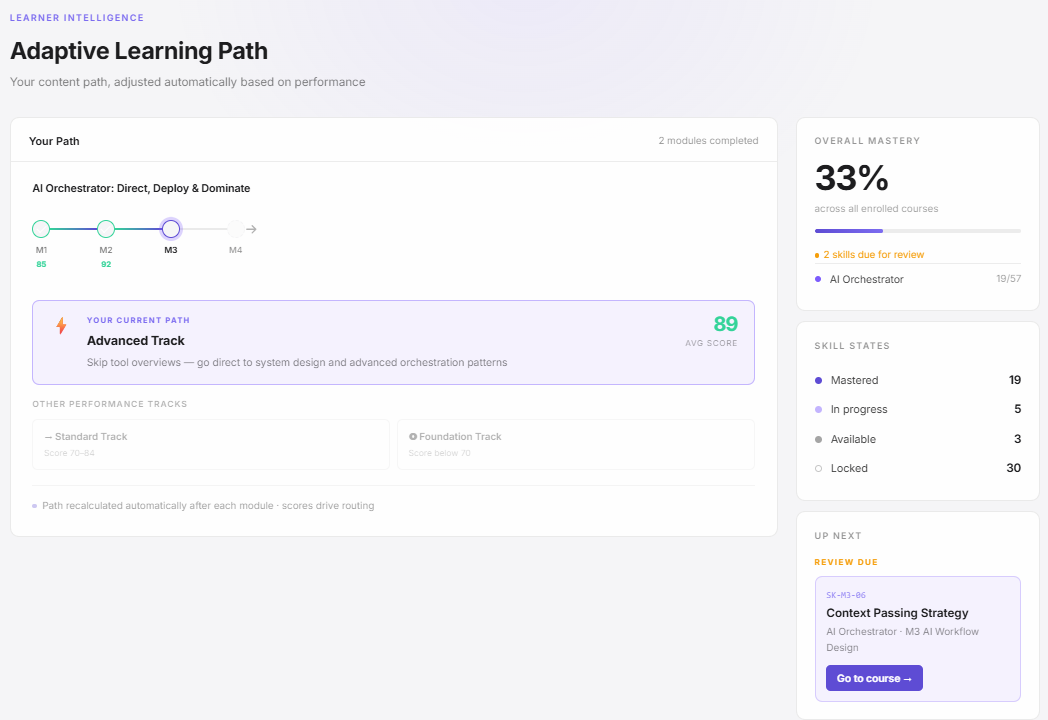
After every module, the system reads the learner's score and routes them into one of three tracks: Advanced (≥ 85%), Standard (70–84%), or Foundation (< 70%). The certification bar never moves — only the scaffolding adapts.
- Real-Time Recalibration.
- Route assigned instantly after each module. No wait, no manual review.
- Smart Recommendations.
- AI surfaces the next highest-priority skill and queues targeted review automatically.
- AI Path Diagnosis.
- On first sign-in, a capability assessment generates a personalised learning-path recommendation before the learner picks a single course.
Skill Map
Every course auto-generates a live visual graph of atomic skills. Each node sits in one of four states — updated after every interaction without manual setup.
08 The Proof Layer
Every bridge task that clears its four-dimension rubric earns a permanent record — GPT-4o graded, timestamped, and posted to a single URL. The learner owns it; employers verify it in a click.
- Graded by GPT-4o.
- Four dimensions: relevance, structure & logic, professional quality, specificity & depth. Localized rubric for Mandarin-language courses.
- What comes back.
- A score (0–100), a headline verdict, specific feedback, one named strength, and one concrete improvement — every time.
- Pass threshold: 70.
- Up to five graded attempts. After the fifth, the learner advances so momentum is never lost — but the record keeps the real score and attempt count. Nothing is hidden from an employer.
- Certificates are permanent.
- They survive any progress reset. Proof of prior work is never lost, even if a learner restarts a course.
09 Learning Hub
Every lesson compounds into a personal knowledge base built entirely from your own work.
Most platforms forget you between sessions. CompassStu accumulates. Every answer you write, every bridge task you submit, every tutor exchange you have — all of it feeds four AI-powered layers that grow with you automatically.
No manual note-taking. No tagging. The system builds your knowledge base while you learn.
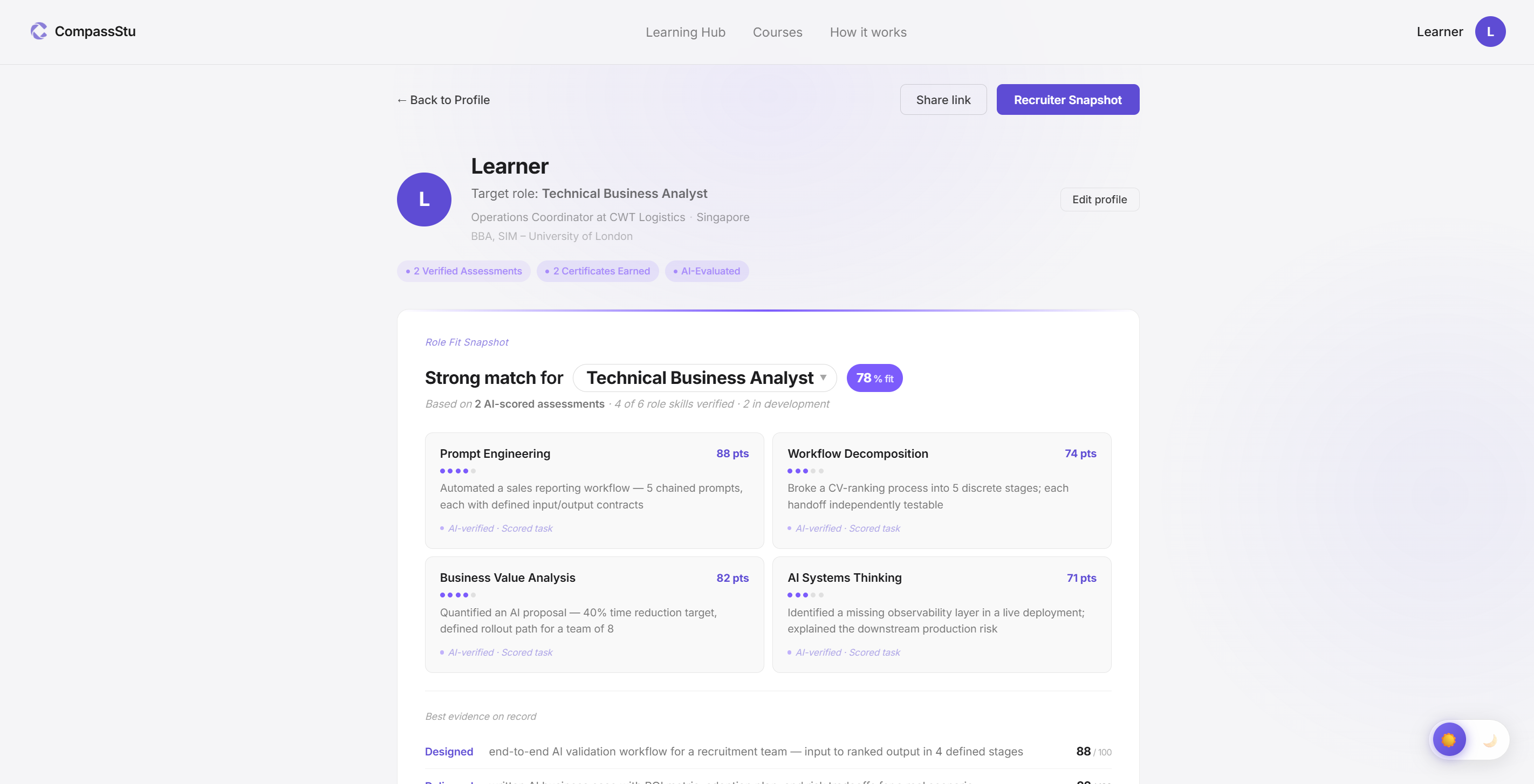
Role Fit Snapshot
Your certificates evaluated in parallel against three target roles.
Knowledge Hub
AI-summarized notes generated automatically from every lesson you complete — a personal knowledge base that grows without any manual effort. Ask it a question and it answers grounded only in your own notes, not the internet.
Ask my notesMy Playbook
AI scans your highest-scoring bridge-task responses and extracts the reusable methods and frameworks inside them. A growing library of your own techniques — not generic best practices, but the specific approaches that worked for you.
Growth Patterns
AI reads across all your submissions to name your recurring strengths and blind spots — quoting your actual words back. Coaching grounded in your real work, not an anonymous rubric average.
Career Proof
AI-generated proof cards that translate your scored submissions into language an employer reads: demonstrated competencies, performance tier, and the specific evidence behind the claim. Not a certificate — a case for your hire.
Shareable public link · employer-readable10 Pathway Ecosystem
We don’t sell courses. We build careers — one verified milestone at a time.
Isolated courses are a commodity — learners finish, earn a certificate, and walk away with no map of what’s next. CompassStu builds structured pathways from beginner to specialist, where each tier unlocks only after AI-verified work samples pass.
- Category tracks, not course catalogs.
- Each pathway maps a domain end-to-end. Learners enter a track; the platform routes them forward based on assessed performance, not manual curation.
- High-demand pathways only.
- Three tracks: AI Product Development, Prompt Engineering & LLM Ops, AI-Augmented Business Analysis. Depth over breadth.
- Retention locked by design.
- A learner mid-pathway has verified competency records and a visible next milestone. Switching platforms means starting over — stickiness by structure, not gamification.
AI Product Thinking
Problem framing, model selection, AI product scoping. Assessment: brief graded against six practitioner criteria.
Prompt Systems & LLM Integration
Prompt systems, RAG, and evaluation loops. Assessment: pipeline graded on consistency and failure-mode coverage.
AI Product Launch & Iteration
GTM strategy, feedback loops, model-improvement cycles. Assessment: launch retrospective with documented iteration decisions.
11 System Map
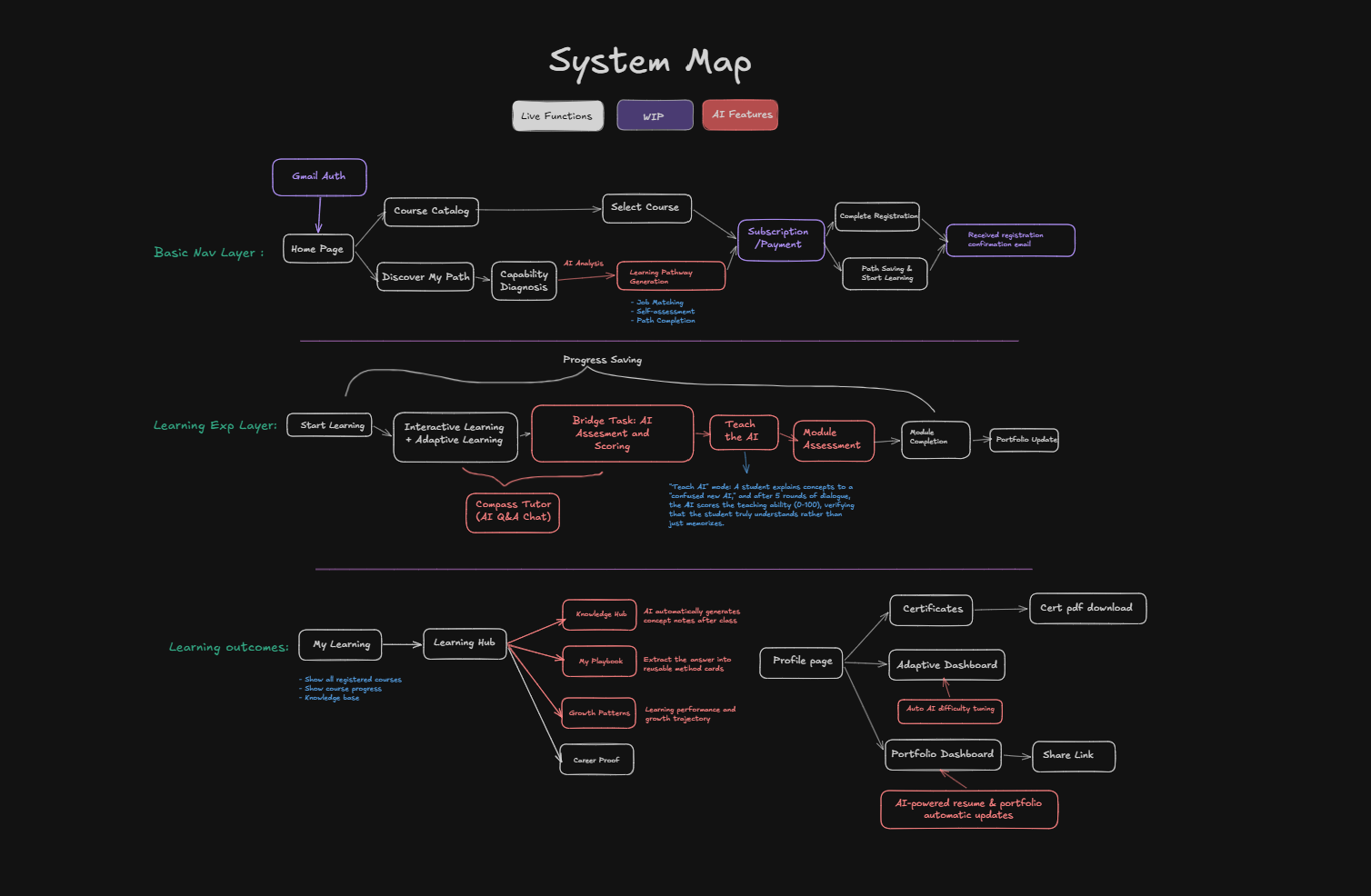
Three layers, each owning a phase of the journey — from first sign-in to shareable proof of work.
Basic Nav Layer
Entry and routing. A learner signs in with Gmail and either browses the catalog or lets Discover My Path diagnose their capability and generate a pathway. Both routes converge at subscription and the first lesson.
Learning Exp Layer
Core delivery. Lessons flow into the bridge task, teach-back, and module assessment, with progress saved continuously. Compass Tutor attaches throughout; Teach the AI verifies comprehension over five rounds before a module closes.
Learning Outcomes Layer
Output and persistence. Completed work feeds the Learning Hub’s four AI artefacts and surfaces on the profile as certificates, dashboards, and a public share link.
12 Content Operation
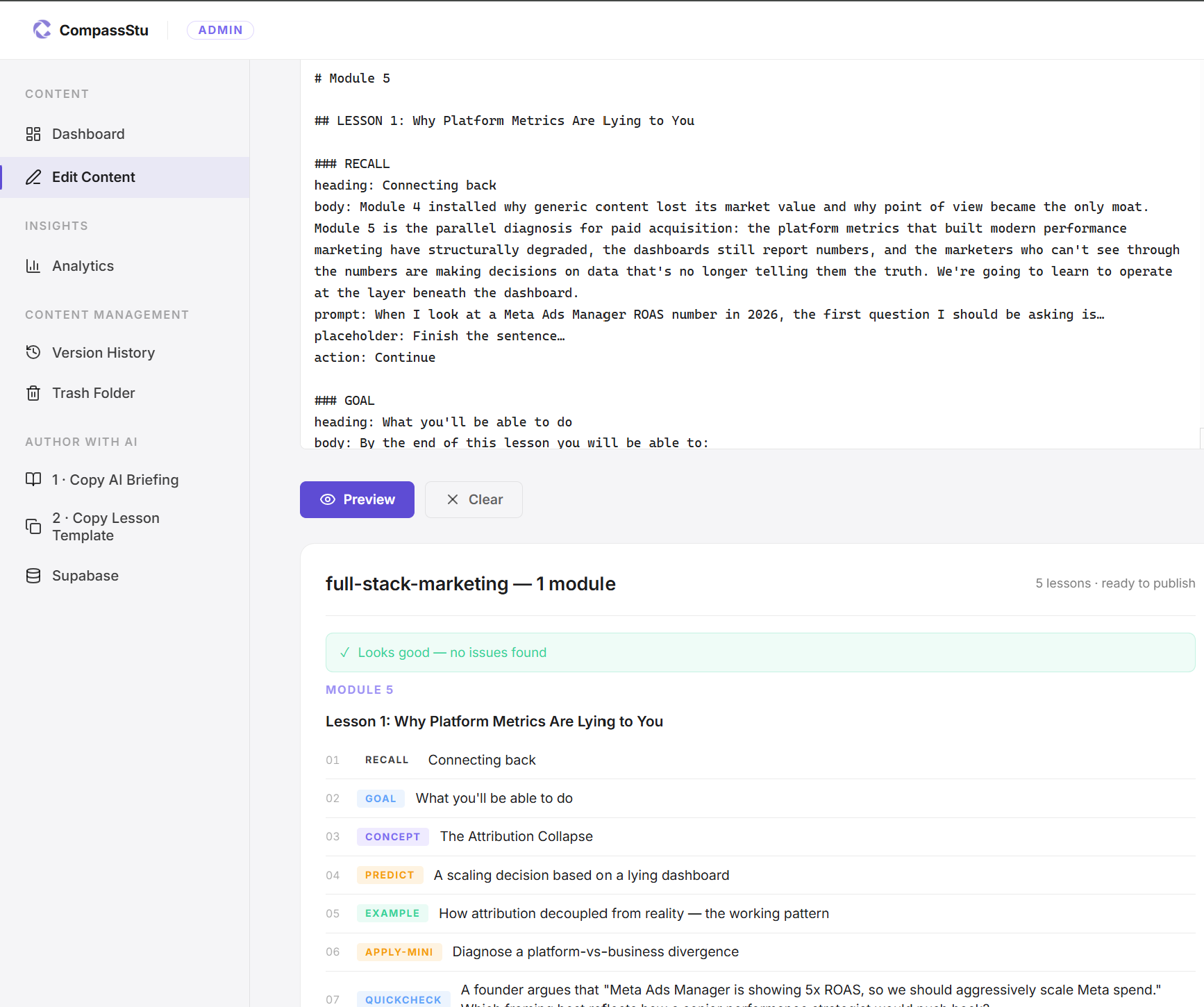
An admin portal lets the content team publish courses end-to-end — no developer required. A markdown→JSONB pipeline writes directly to the database; a publish is live on the next page load.
- Dual-runtime parser.
- One parser, two runtimes — Node CLI for batch ingest, browser module for in-editor publish.
Output: typed JSON into
lessons.lesson_data. - Round-trippable format.
- JSON re-hydrates to editable markdown automatically. No export step, no stale drafts.
- Idempotent publish, 24h rollback.
- Upsert on
(course_slug, module_number, lesson_number). A DB trigger snapshots prior rows intolesson_versions— version history without app code. - Live AI tutor config.
- Tutor prompt and scope live in
course_ai_context, read on every chat turn. Admin saves reflect instantly. - Course Discovery Index.
- Every publish writes course structure and objectives into the discovery index. Discover My Path reads this in real time — no manual tagging, no developer updates. New course. Live recommendations.
13 Tech Architecture
Four infrastructure decisions, each made so one person could run an entire platform.
Nothing on CompassStu is hardcoded into a page. The site is a thin runtime over a database — content, configuration, and AI behaviour all live as data and ship without a deploy.
- Content is data, not pages.
- Every lesson, course, and tutor prompt lives in Supabase Postgres. Pages pull from the database on load — publishing new content never touches the codebase.
- AI behind the edge.
- Every model call — grading, tutoring, path diagnosis — runs through Supabase Edge Functions. API keys never reach the client; every AI feature shares one governed gateway.
- Auth and ownership built in.
- Supabase Auth with row-level security. A learner’s record belongs to them; a proof URL is public only because its owner chose to share it.
- Zero-ops deployment.
- Vercel — push to ship, a preview per change, no servers to maintain. A solo team’s operations budget spent on product, not infrastructure.
14 Brand & Visual Design
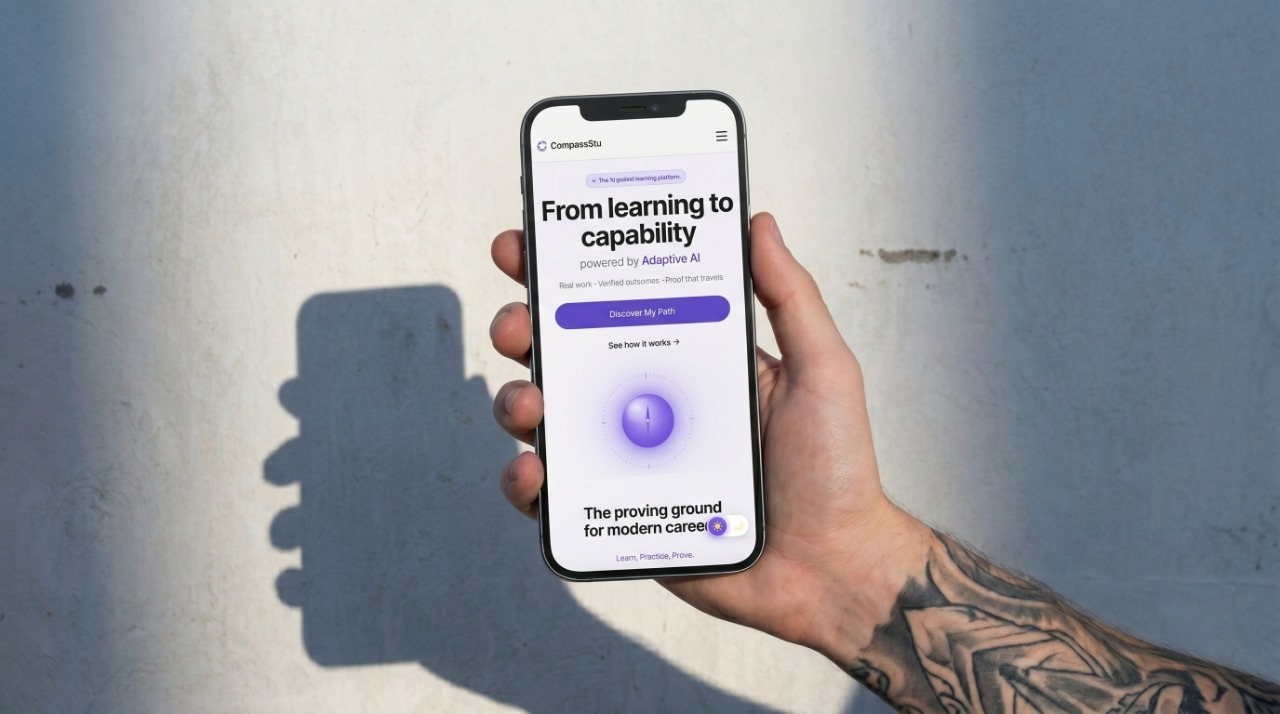
One typeface. One violet accent. Restraint as a design position, not a limitation.
Alpha-based neutrals throughout — every surface, dark or light, derives from the same palette. Nothing on the page competes with the work.
15 Results
Designed, built, and shipped solo in three months.
CompassStu runs end-to-end today: sign-in, adaptive lessons, AI-graded bridge tasks, verifiable proof URLs, and an admin portal that publishes courses without a developer — in English and Mandarin.
- What shipped.
- The full loop — auth, learning runtime, AI grading, permanent certificates, content CMS — designed, built, and operated by one person.
- What I’d measure first.
- Whether the proof carries: do employers open the share link, and does a verified record change a screening decision. That — not completion rate — is the metric this product lives or dies on.
- What I’d revisit.
- The five-attempt advance. It protects momentum but pulls against the fixed standard — the next iteration separates “module unlocked” from “certificate earned” completely.
- What’s next.
- An employer-side view: rubric evidence and work samples side by side, designed for a ninety-second screening read.